
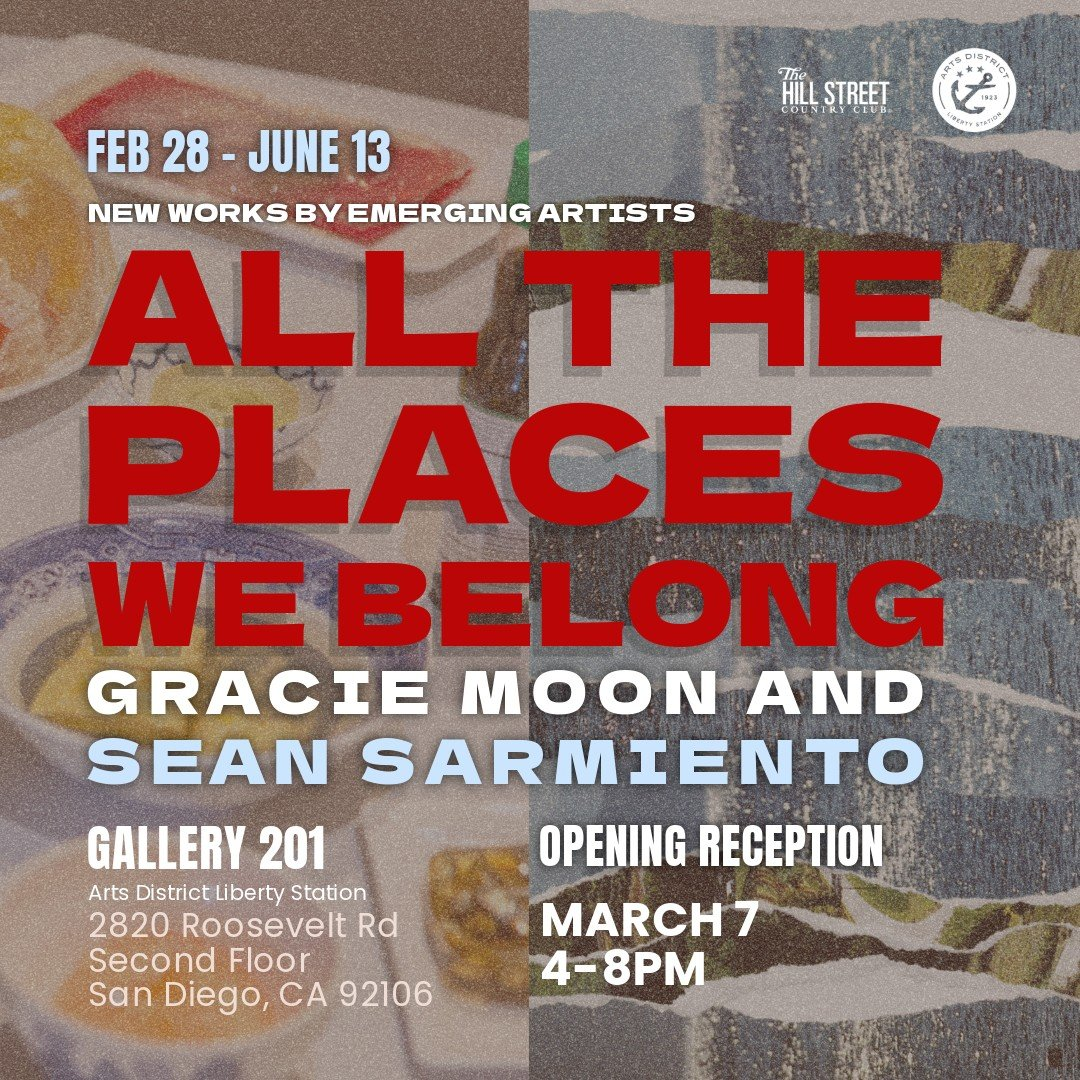
"All the Places We Belong" examines the interplay between identity, memory, and domestic space through the works of Sean Sarmiento and Gracie Moon. Sean and Gracie are participants in Arts District Liberty Station’s Emerging Visual Artist Program , an initiative to foster emerging artists in the San Diego/Northern Baja Region. This exhibition represents 6 months of self-directed studio work in collaboration with David G. Fleet Curator-in-Residence Dinah Poellnitz and celebrates the growth in each artist's practice as they participate in an ever evolving creative environment. In “All the Places We Belong,” both artists navigate the psychological and cultural resonance of home as a space where identities are inherited, constructed, questioned, and reclaimed.
Sean Sarmiento’s collages romanticize home combining typography, pattern, and vernacular architecture in syrupy amber tones. Found textures float on the void of Sean’s pages, overlapping softly focused photography interrupted by lens flares and light leaks from the instant polaroid camera that has become central to his process. By pushing the making of images away from crisp depictions of reality and embracing the chemical spontaneity typical of instant film, Sean transforms familiar excerpts into intimate emotional landscapes that feel like warm memories. His work reimagines the home as a stage for vulnerability, familial connection, and deep introspection, one that is constructed via direct intervention and casual intimacy layered on top of each other over time. Sean’s work invites viewers to sink into a feeling of care and make room for imagination as they might within their own safe spaces.
Gracie Moon’s works critically examine how concepts of heritage and identity are commodified and preserved in the personal and domestic spheres. Her art is deeply informed by childhood memories of gatherings where Japanese and American dishes shared the same table, a convergence that reflects her multiracial experience. In sculptural works including clear resin jello molds holding Japanese food wrappers and produce with staring googly-eyes, Gracie delves into conversations around food as a cultural experience. Her works also reflect on the unspoken stories of her Japanese grandparents', whose experiences during and after World War II remain absent from family memory. Her Pinterest screenshots show an endless scroll of collected images that form a case study on how to visually inhabit and practice Asain-ness. Gracie mines the internet as a cultural archive populated by photo tutorials and fantasy avatars steering online viewers towards buyable products to “complete the look”. Blending personal histories with whimsical speculative narratives, Gracie’s works question how identity is impacted by the tendency of Western-centric narratives to flatten “othered” cultures to consumable objects.
Together, Sean and Gracie’s practices reimagine the home as a site of profound engagement—a place where care and critique coexist, and where memory and identity are continuously shaped and reshaped. "All the Places We Belong" invites viewers to reflect on their own experiences of belonging, encouraging an appreciation for the intimate, complex, and layered spaces we inhabit both physically and socially.
About the Artists:
Gracie Moon
Gracie Moon is a San Diego-based sculpture artist and emerging graduate from Point Loma Nazarene University (BA, Visual Arts, 2024). Her work investigates the intersections of racial and cultural identity, heritage, and domesticity. As a multiracial Japanese American, Gracie explores the complexities of living in an in-between space, oscillating between breaking, mending, losing, and finding. Her sculptures often incorporate food, found objects, and domestic materials to create visual poetry that examines cultural commodification and self-connection.
Gracie draws from personal experiences, such as family gatherings where Japanese and American dishes coexisted on one table, and visits to Japanese markets that sparked her fascination with identity through commodified goods. Her art critiques how Western-centric narratives reduce Japanese culture to objects, while also reflecting the absence of historical context from her family, particularly the unspoken stories of her grandparents during wartime incarceration. Through pieces like jello molds of Japanese dishes and quilts made from nori, Gracie crafts speculative narratives that reclaim heritage and invite viewers to reflect on the complexities of cultural identity.
Sean Sarmiento
Sean Sarmiento is a mixed-media artist and a graduate of the University of San Diego (BA, Visual Arts, 2023), where he received departmental honors and awards for exceptional performance. His practice bridges photography, collage, sculpture, and installation to explore themes of home, Queer identity, and the domestic sphere. Sean uses his art to challenge traditional architectural and photographic norms, using them as a framework to craft intimate, inclusive, and emotionally resonant representations of home. Through this lens, Sean’s work transforms domestic spaces into sanctuaries of belonging and affirmation, highlighting the profound connection between identity and the familiar rhythms of daily life.
Sean’s work highlights the "in-betweenness" of identity, capturing moments and feelings that are simultaneously unknown and familiar. Through self-portraits within domestic spaces and the manipulation of photographic elements, Sean reimagines home as a site of inclusion and emotional resonance. His works often incorporate innovative materials, such as folded vinyl and layered prints, to blur the boundaries between two-dimensional and three-dimensional forms, creating a tactile and immersive experience.
Press Mentions
About Hill Street Country Club:
An art gallery non-profit, at HSCC our curatorial practice is rooted in Personal, Communal, and Universal connections, shaping exhibitions that foster relationships between artists, audiences, and the broader community. As a horizontal curatorial team, we collaborate through shared knowledge and creative labor, ensuring equity, mutual respect, and inclusion.
Our work prioritizes radical accessibility, experimentation, and systemic change—creating spaces where art thrives as a tool for dialogue and transformation.
HSCC Curatorial Team
Dinah Poellnitz, Founding Curator & Visionary Strategist
Akiko Surai, Assistant Curator
Astrid Gonzales, Audio/Visual Curator
