
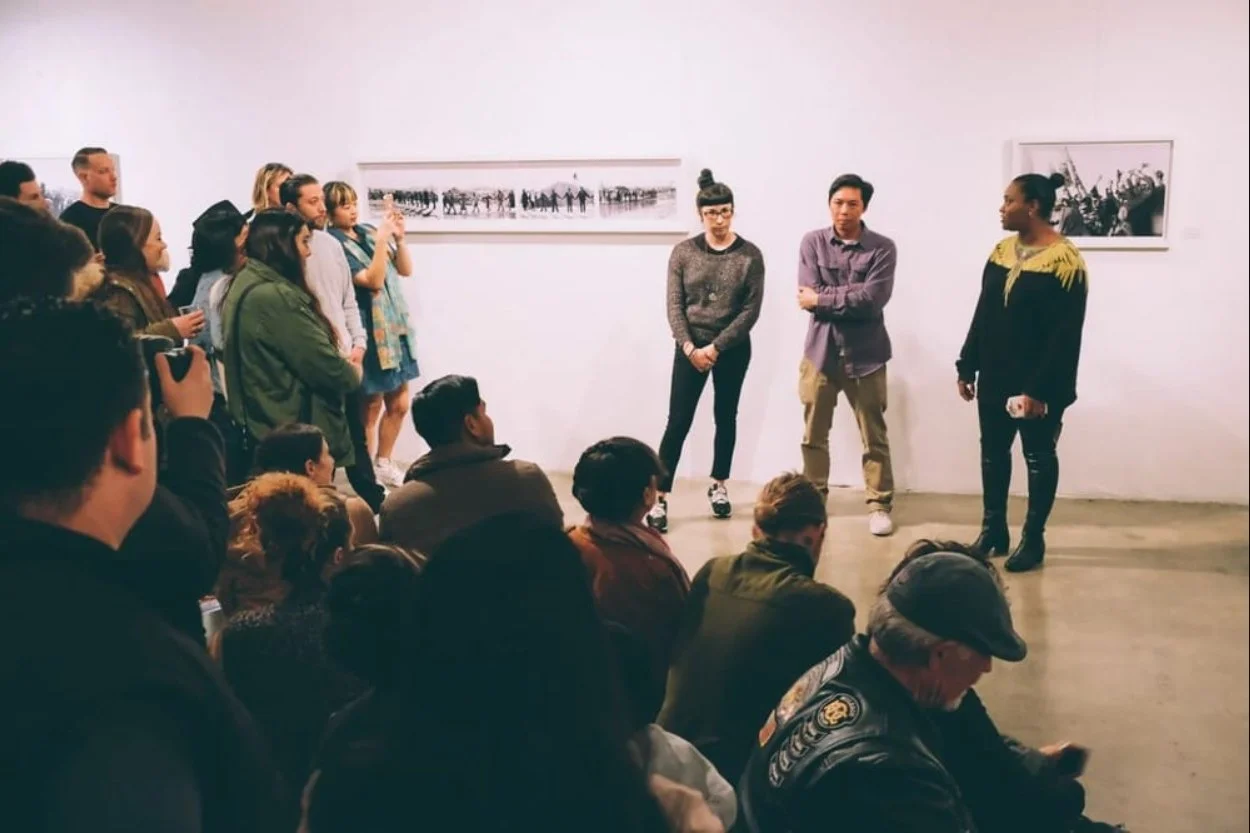
Attendees at Johnny Nguyen’s open reception for And If I Can Show You, You Would Never Leave Her at the Hill Street Country Club, 2019, with co-founders Dinah Poellnitz (right) and Margaret Hernandez (left) with artist Johnny Nguyen (middle) (photo by James Guerrero, courtesy Hill Street Country Club)
This year the Hill Street Country Club (HSCC) celebrates its tenth anniversary. Founded in 2012 by Margaret Hernandez and Dinah Poellnitz, who met working at the Oceanside Art Museum, the HSCC reflects and celebrates the cultural and socioeconomic diversity of the San Diego-Tijuana region. “We are a place of liberation, where our artists can say how they feel when they feel it, and not be punished or shamed or told that it doesn’t sell,” Poellnitz said. Poellnitz and Hernandez became deeply involved in local politics, attending municipal government meetings to assess and increase the support for local arts infrastructure. Their experiences reinforced what they already knew: Traditional institutions and exhibition opportunities are often inaccessible to working class and BIPOC artists. “There are so many artists who don’t exhibit or don’t practice art in our community because they simply don’t have a place to let them know that they’re artists,” Poellnitz told me. “We had to organize.”
HSCC maintains a schedule of experimental exhibitions, collaborative pop-up events, and community programs. Ongoing initiatives include The Social, which comprises monthly group therapy meetings and a related art therapy summer camp program for middle schoolers, and Soft U, a digitally broadcast live music series. Through the HSCC, Poellnitz and Hernandez have created a community-based art model that is nimble, rhizomatic, and deeply personal. “Everything that Marge and I did was from personal experience,” said Poellnitz. “And then when we started to tell that story out loud, or organize behind it, we learned that there was a community that had a similar experience. The purpose of art in our space is to drop seeds of memories and conversations, so people can find out who their community is.”
Read the whole article by Jordan Karney Chaim for Hyperallergic